Industrial Automation Software Guide: Cloud, SCADA & Digital Twins
Industrial automation is the use of machines, control systems, software, sensors, robotics, and data technologies to perform and monitor manufacturing activities with limited manual intervention. It is a major part of Industry 4.0, where physical production systems are connected with digital technologies.
Traditional manufacturing often depends on operators to control machines, inspect products, record measurements, and respond to production changes. Automation introduces programmable systems that can monitor conditions, execute predefined processes, and communicate production data.
Modern industrial automation solutions can include:
- Programmable Logic Controllers (PLCs)
- Human-Machine Interfaces (HMIs)
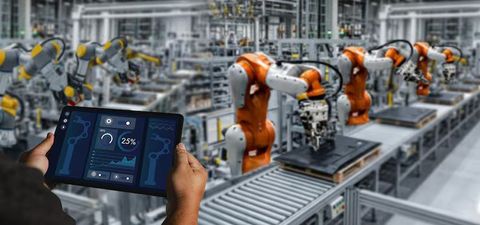
- Industrial robots and collaborative robots
- Industrial Internet of Things (IIoT) sensors
- Machine vision systems
- Manufacturing execution systems
- Industrial control systems
- Artificial intelligence and machine learning
- Digital twins
- Automated material-handling systems
- Predictive maintenance platforms
The development of automation has progressed from simple mechanical controls to connected systems capable of collecting and analyzing large amounts of production data.
AI is now adding another layer. Instead of only following programmed instructions, AI-based systems can analyze patterns, identify anomalies, support quality inspection, and help manufacturers make data-informed decisions.
How Smart Manufacturing Works
Smart manufacturing connects machines, people, software, and data.
A typical production environment may use sensors to collect information about temperature, vibration, pressure, speed, energy consumption, or machine status. Controllers process operational signals, while software platforms organize production information.
A simplified flow looks like this:
Sensors → Controllers → Machines/Robots → Data Platform → Analytics/AI → Production Decisions
This connected approach can make manufacturing operations easier to monitor and analyze.
Importance
Why Industrial Automation Matters Today
Industrial automation matters because manufacturers increasingly need consistent quality, efficient production, better equipment monitoring, and greater flexibility.
Automation can help address several common manufacturing challenges:
- Repetitive production activities
- Manual measurement and inspection
- Equipment downtime
- Production errors
- Inconsistent process conditions
- Limited visibility into machine performance
- Increasing data volumes
- Complex production scheduling
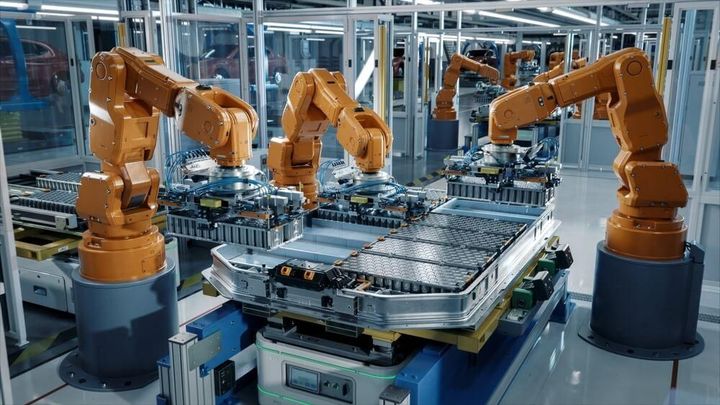
Robotics can handle repetitive physical activities, while machine vision can inspect components using cameras and image-processing algorithms. AI can analyze production information and identify patterns that may not be immediately visible through manual monitoring.
AI and Robotics in Manufacturing
AI and robotics are increasingly being considered together rather than as separate technologies.
Robots provide physical movement and automation. AI can provide analytical capabilities that help systems interpret information and respond to changing conditions.
Examples include:
- AI-assisted visual inspection
- Robotic assembly
- Automated material handling
- Predictive maintenance
- Production scheduling
- Digital quality monitoring
- Warehouse automation
- Process optimization
- Energy monitoring
- Defect detection
India's NITI Aayog advanced-manufacturing roadmap published in October 2025 identified AI and machine learning, digital twins, and robotics as important technologies across priority manufacturing sectors.
Who Is Affected?
Industrial automation affects a wide range of industries and stakeholders, including:
- Automotive manufacturing
- Electronics production
- Pharmaceuticals
- Food processing
- Chemicals
- Steel
- Textiles
- Packaging
- Energy equipment
- Logistics and warehousing
- Small and medium manufacturing enterprises
It also changes the skills needed in modern factories. Workers increasingly interact with control software, sensors, robotics, industrial networks, data platforms, and automated inspection systems.
India's Skill India initiatives have included AI, machine learning, robotics, IoT, data analytics, cloud computing, and cybersecurity among emerging technology areas for skills development.
Common Automation Technologies
| Technology | Typical Manufacturing Role |
|---|---|
| PLC | Machine and process control |
| HMI | Operator-machine interaction |
| Robotics | Repetitive physical operations |
| Machine Vision | Automated inspection |
| IIoT | Machine data collection |
| AI/ML | Pattern analysis and prediction |
| Digital Twin | Virtual process representation |
| MES | Production monitoring and coordination |
| SCADA | Supervisory monitoring and control |
Recent Updates
AI-MET and Manufacturing
A significant development in India occurred on 18 February 2026, when the Ministry of Electronics and Information Technology highlighted priorities for AI in Manufacturing Engineering Technology and introduced the AI-MET White Paper concept.
The initiative emphasized responsible and scalable AI adoption, skills development, productivity, sustainability, and industrial innovation.
Robotics Roadmap Discussions
On 3 February 2026, India's Technology Advisory Group discussed the country's robotics ecosystem and a strategic roadmap for robotics. Advanced robotic technologies were identified as an important area for continued development.
Advanced Manufacturing Strategy
On 23 February 2026, the Office of the Principal Scientific Adviser and Ministry of Heavy Industries held a stakeholder consultation concerning an Advanced Manufacturing Systems Mission. The discussion included manufacturing enterprises, MSMEs, startups, research organizations, academia, and technology developers.
Digital Manufacturing and Steel
In June 2026, the Ministry of Steel highlighted AI, machine learning, industrial IoT, digital twins, robotics, and advanced data analytics as technologies relevant to the digital transformation of steel manufacturing.
These developments show that smart manufacturing technology is increasingly being discussed as part of broader industrial modernization rather than simply as machine automation.
Laws or Policies
India's Policy Environment
Industrial automation in India is affected by several overlapping areas of regulation and government policy. These can include industrial safety, electrical safety, environmental requirements, data protection, cybersecurity, machinery standards, workplace rules, and sector-specific regulations.
Manufacturers should identify requirements applicable to their particular machinery, facility, industry, and state.
AI Governance
India's AI governance discussions have developed alongside the expansion of AI applications. In January 2026, the Office of the Principal Scientific Adviser published a white paper describing a techno-legal approach involving baseline safeguards, sector-specific rules, technical controls, and institutional mechanisms.
For industrial AI, organizations should therefore consider:
- Data governance
- Cybersecurity
- Human oversight
- System reliability
- Access controls
- Auditability
- Responsible AI practices
National Manufacturing Initiatives
The government has also introduced programs supporting manufacturing infrastructure and advanced technology.
In March 2026, the Union Cabinet approved the Bharat Audyogik Vikas Yojna (BHAVYA) with an allocation of ₹33,660 crore for 100 plug-and-play industrial parks. Detailed implementation guidelines were subsequently released in May 2026.
India's National Mission on Interdisciplinary Cyber-Physical Systems (NM-ICPS) also covers technologies including AI, IoT, robotics, autonomous systems, data analytics, and cybersecurity. The mission has an approved outlay of ₹3,660 crore for 2018–2027.
The specific compliance requirements for an automated factory can vary considerably by industry and application, so general technology guidance should not be treated as legal advice.
Tools and Resources
Useful Industrial Automation Tools
Manufacturers and learners can use several categories of tools when planning or studying automation systems:
- PLC programming software: Used to develop and test control logic.
- HMI design tools: Used to create operator screens and machine dashboards.
- SCADA platforms: Used for supervisory monitoring and process visualization.
- CAD software: Used for mechanical layouts and equipment design.
- Simulation software: Helps model automated processes before physical deployment.
- Digital twin platforms: Create virtual representations of equipment or production systems.
- Data analytics tools: Help identify production patterns and equipment conditions.
- Machine-vision software: Supports image-based inspection and measurement.
- Energy-monitoring calculators: Help analyze electricity consumption across equipment.
- Cybersecurity assessment templates: Help document industrial network risks.
- Technical standards databases: Provide information about applicable engineering and safety requirements.
- Online engineering courses: Useful for learning PLCs, robotics, AI, sensors, and industrial networking.
A practical automation project normally starts with process mapping and data collection before selecting technologies.
A Simple Automation Planning Framework
- Identify the manufacturing process.
- Document repetitive or error-prone activities.
- Determine what information needs to be measured.
- Identify suitable sensors and controllers.
- Assess whether robotics or machine vision is appropriate.
- Consider cybersecurity and operational safety.
- Test the concept through simulation where practical.
- Establish performance measurements.
- Train relevant personnel.
- Monitor the system after deployment and make controlled improvements.
FAQs
What Is Industrial Automation?
Industrial automation uses control systems, machines, software, sensors, and robotics to perform or monitor manufacturing activities with reduced manual intervention.
How Does AI Support Smart Manufacturing?
AI can analyze production data, identify patterns, detect anomalies, support visual inspection, assist maintenance planning, and improve decision-making. Its usefulness depends on data quality, system design, and appropriate human oversight.
What Is the Difference Between Automation and Smart Manufacturing?
Automation focuses primarily on controlling and performing processes automatically. Smart manufacturing adds connected data, analytics, AI, digital systems, and communication between production resources.
Are Robots the Same as Industrial Automation?
No. Robots are one component of industrial automation. A complete automation system can also include PLCs, sensors, HMIs, machine vision, industrial networks, software, safety systems, and data platforms.
Is Industrial Automation Suitable for Every Factory?
The appropriate level of automation depends on the production process, product characteristics, operating environment, safety requirements, available infrastructure, workforce skills, and technical objectives. Automation should be selected according to the specific process rather than applied uniformly.
Conclusion
Industrial automation is evolving from machine-based control toward connected and intelligent manufacturing. PLCs, sensors, robotics, machine vision, IIoT, AI, and digital twins can work together to create production environments with greater visibility and automation.